Yees Martial Arts Lion Dance Yees Martial Arts Lion Dance
| Panthera leo dance | |||||||||||
|---|---|---|---|---|---|---|---|---|---|---|---|
 | |||||||||||
| Chinese proper noun | |||||||||||
| Traditional Chinese | 舞獅 | ||||||||||
| Simplified Chinese | 舞狮 | ||||||||||
| |||||||||||
| Alternative Chinese proper name | |||||||||||
| Traditional Chinese | 跳獅 or 弄獅 | ||||||||||
| |||||||||||
| Vietnamese name | |||||||||||
| Vietnamese alphabet | múa lân / sư tử | ||||||||||
| Chữ Nôm | 𦨂麟 / 獅子 | ||||||||||
| Korean proper name | |||||||||||
| Hangul | 사자춤 | ||||||||||
| Hanja | 獅子춤 | ||||||||||
| |||||||||||
| Japanese name | |||||||||||
| Kanji | 獅子舞 | ||||||||||
| |||||||||||
| Indonesian name | |||||||||||
| Indonesian | barongsai | ||||||||||
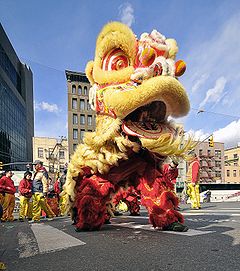
Panthera leo dance (traditional Chinese: 舞獅; simplified Chinese: 舞狮; pinyin: wǔshī ) is a class of traditional dance in Chinese civilisation and other Asian countries in which performers mimic a lion's movements in a lion costume to bring good luck and fortune. The king of beasts trip the light fantastic toe is usually performed during the Chinese New Yr and other Chinese traditional, cultural and religious festivals. It may also be performed at of import occasions such every bit business concern opening events, special celebrations or wedding ceremonies, or may be used to honor special guests by the Chinese communities.
The Chinese lion dance is ordinarily operated past two dancers, i of whom manipulates the head while the other forms the rear end of the lion. It is distinguishable from the dragon dance which is performed by many people who hold the long sinuous body of the dragon on poles. Chinese panthera leo trip the light fantastic fundamental movements can be plant in Chinese martial arts, and it is normally performed to a vigorous drum vanquish.
There are ii principal forms of the Chinese lion dance, the Northern Panthera leo and the Southern Lion. Both forms are commonly establish in Cathay and effectually the world particularly in Southeast Asia, the Southern King of beasts predominates as it was spread by the Chinese diaspora communities who are historically mostly of Southern Chinese origin. Versions of panthera leo dance related to the Chinese lion are also found in Japan, Korea, Taiwan, Tibet and Vietnam. Besides the Chinese-based panthera leo dance, the other forms of king of beasts trip the light fantastic toe also exist in Indonesia, for example the Barong dance in Javanese and Balinese cultures.
History [edit]
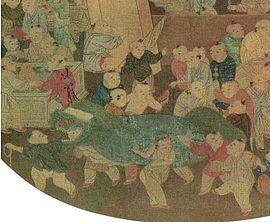
Details of the Vocal Dynasty painting "1 Hundred Children Playing in the Spring" (百子嬉春图页) by Su Hanchen (苏汉臣) showing children performing the lion trip the light fantastic.
At that place has been an sometime tradition in China of dancers wearing masks to resemble animals or mythical beasts since antiquity, and performances described in ancient texts such equally Shujing where wild beasts and phoenix danced may take been masked dances.[i] [ii] In Qin Dynasty sources, dancers performing exorcism rituals were described equally wearing bearskin mask,[1] and it was also mentioned in Han Dynasty texts that "mime people" (象人) performed as fish, dragons, and phoenixes.[iii] [four] Still, panthera leo is non native to China (a species found in Northeast Cathay Panthera youngi had long go extinct),[5] and the Lion Dance therefore has been suggested to accept originated outside of Mainland china from countries such equally Bharat or Persia,[6] [seven] and introduced via Cardinal Asia.[8] According to ethnomusicologist Laurence Picken, the Chinese give-and-take for panthera leo itself, shi (獅, written every bit 師 in the early on periods), may have been derived from the Persian word šer.[9] The primeval apply of the discussion shizi meaning king of beasts start appeared in Han Dynasty texts and had stiff association with Key Asia (an even before but obsolete term for king of beasts was suanni (狻麑 or 狻猊), and lions were presented to the Han court by emissaries from Fundamental Asia and the Parthian Empire.[x] Detailed descriptions of Lion Trip the light fantastic toe appeared during the Tang Dynasty and it was already recognized by writers and poets then every bit a foreign dance, withal, Lion trip the light fantastic may accept been recorded in China equally early on as the third century Ad where "king of beasts acts" were referred to past a 3 Kingdoms scholar Meng Kang (孟康) in a commentary on Hanshu.[11] [12] [13] In the early periods it had association with Buddhism: it was recorded in a Northern Wei text, Description of Buddhist Temples in Luoyang (洛陽伽藍記), that a parade for a statue of Buddha of a temple was led by a lion to bulldoze away evil spirits.[12] [xiv] [15] An culling proffer is therefore that the trip the light fantastic may take adult from a local tradition that appropriated the Buddhist symbolism of king of beasts.[5]

Japanese illustration of a Lion Trip the light fantastic toe that some argued represents the Tang Dynasty lion dance described by Bai Juyi.[16] The original painting is dated to the Heian catamenia.
There were dissimilar versions of the dance in the Tang Dynasty. In the Tang court, the lion trip the light fantastic was chosen the Great Peace Music (太平樂, Taiping yue) or the Lion Dance of the Five Directions (五方師子舞) where five large lions of unlike colours and expressing different moods were each led and manipulated on rope by two persons, and accompanied past 140 singers.[12] [17] In another account, the 5 lions were described every bit each over iii metres tall and each had 12 "lion lads", who may tease the lions with blood-red whisks.[12] [xviii] [xix] Some other version of the lion trip the light fantastic toe was described past the Tang poet Bai Juyi in his poem "Western Liang Arts" (西凉伎), where the trip the light fantastic was performed by two hu (胡, meaning here non-Han people from Central Asia) dancers who wore a lion costume made of a wooden head, a silk tail and furry body, with eyes gilded with golden and teeth plated with silver as well as ears that moved, a form that resembles today's Lion Trip the light fantastic toe.[12] [20] [21] Past the eighth century, this panthera leo trip the light fantastic had reached Nihon. During the Song Dynasty the panthera leo trip the light fantastic toe was commonly performed in festivals and it was known as the Northern Lion during the Southern Song.
The Southern Lion is a later development in the due south of China originating in the Guangdong province. There are a number of myths associated with the origin of the Southern Panthera leo: 1 story relates that the trip the light fantastic originated as a commemoration in a village where a mythical monster chosen Nian was successfully driven away;[eight] [22] another has it that the Qianlong Emperor dreamt of an auspicious brute while on a tour of Southern China, and ordered that the paradigm of the animal be recreated and used during festivals. Even so information technology is likely that the Southern Lion of Guangzhou is an accommodation of the Northern Lion to local myths and characteristics, perhaps during the Ming Dynasty.[23] [24]
Regional types [edit]
The two main types of lion dance in Mainland china are the Northern and Southern Lions. There are yet also a number of local forms of panthera leo dance in different regions of Mainland china, and some of these lions may have significantly differences in appearance, for example the Green or Hokkien Lion (青獅, Qing Shi) and the Taiwanese or Yutien Panthera leo (明狮, Ming Shi),[ citation needed ] popular with the Hokkien and the Taiwanese people.[25] [26] [27] Other indigenous minorities groups in Cathay also take their own lion dances, for case, the lion dance of the Muslim minority in Shenqiu County in Henan chosen the Wen Lion,[28] [29] the Yongdeng lion trip the light fantastic in Yongdeng County, Lanzhou, Gansu,[30] the lion dance in Yongning County, and Wuzhong, Ningxia,[ commendation needed ]and the Hakka Panthera leo — popular with the Hakka people, which is very similar to both the Hokkien and Taiwanese Lions and even the Wen Lion, but the Hakka lion may or may not have a horn on its head.[ citation needed ] Chinese king of beasts dances usually involve ii dancers but may also be performed by one. The larger lions manipulated by two persons may exist referred to as great lions (太獅), and those manipulated by one person picayune lions (少獅). The performances may too be broadly divided into civil (文獅) and martial (武獅) styles. The civil style emphasizes the graphic symbol and mimics and behaviour of the panthera leo, while the martial mode is focused on acrobatics and energetic movements.[31]
In that location are related forms of dances with mask figures that represent mythical creatures such as the Qilin and the Pixiu.[32] The Qilin trip the light fantastic and the Pixiu dance are also virtually commonly performed past the Hakka people who were originally from the Central China, but have largely settled in the south of Cathay and southeast Asia in mod times.[33] [34]
Various forms of lion dance are also found widely in Due east Asian countries such every bit Japan, Korea, Vietnam, as well as among the communities in the Himalayan region.
Chinese Northern King of beasts [edit]

The Chinese Northern King of beasts (simplified Chinese: 北狮; traditional Chinese: 北獅; pinyin: Běi shī ) Dance is often performed as a pair of male and female lions in the north of China. Northern lions may have a gold-painted wooden head, and shaggy carmine and yellow pilus with a cherry bow on its head to bespeak a male person lion, or a green bow (sometimes green hair) to represent a female.[35] In that location are yet regional variations of the lion.
Northern lions resemble Pekingese or Foo Dogs/Fu Dogs, and their movements are lifelike during a performance. Acrobatics is very common, with stunts like lifts, or balancing on a tiered platform or on a giant brawl. Northern lions sometimes appear as a family unit, with two large "developed" lions and a pair of small "young" lions. At that place are usually two performers in one adult lion, and ane in the immature lion. There may also be a "warrior" character who holds a spherical object and leads the lions.[36]
The dance of the Northern Panthera leo is more often than not more playful than the Southern Panthera leo. Regions with well-known lion dance troupes include Ninghai in Ningbo, Xushui in Hebei province, Dalian in Liaoning province, and Beijing. At that place are a number of variations of the panthera leo dance performance, for example the Heavenly Tower Lion Dance (simplified Chinese: 天塔狮舞; traditional Chinese: 天塔獅舞; pinyin: Tiān tǎ shī wǔ ) from Xiangfen County in Shanxi is a functioning whereby a number of lions climb up a alpine tower structure synthetic out of wooden stools,[23] and there are as well high-wire acts involving lions
Chinese Southern Lion [edit]


Cantonese king of beasts dance troupe holding a Rui shi (瑞狮;, "cheering lion") sign in the late 19th century.
The Chinese Southern Lion (simplified Chinese: 南狮; traditional Chinese: 南獅; pinyin: Nán shī ) or Cantonese Panthera leo dance originated from Guangdong. The Southern Lion has a single horn, and is associated with the legend of a mythical monster chosen Nian. The panthera leo's caput is traditionally constructed using papier-mâché over a bamboo frame covered with gauze, then painted and decorated with fur.[37] [38] Its body is made of durable layered material as well trimmed with fur. Newer lions, notwithstanding, may exist made with modernistic materials such as aluminium instead of bamboo and are lighter.[39] Newer versions may also apply shinier modern material over the traditional lacquer such as sequin or laser sticker, but they do not last as long as those with lacquer. Unlike types of fur may exist used in modern lions.
There are two main styles of Southern Lion: the Fut San or Fo Shan (Chinese: 佛山; pinyin: Fóshān ; lit. 'Buddha Mountain'), and the Hok San or He Shan (simplified Chinese: 鹤山; traditional Chinese: 鶴山; pinyin: Hèshān ; lit. 'Crane Mount'), both named after their place of origin. Other minor styles include the Fut-Hok (a hybrid of Fut San and Hok San created in Singapore by Kong Chow Wui Koon in the 1960s), and the Jow Ga (performed by practitioners of Jow family unit fashion kung fu).[35] The different panthera leo types can be identified from the design of the lion head.
Fo Shan is the way adopted by many kung fu schools. It uses kung fu moves and postures to assist with its movements and stances, and only the nearly avant-garde students are allowed to perform. Traditionally, the Fo Shan king of beasts has bristles instead of fur, and is heavier than the modern ones at present popularly used. All traditional Fo Shan lions have pop-up teeth, natural language, and eyes that hinge left and right. On the back are gold-foiled rims and a gilded collar where the troupe'south name may exist sewn on. It has a very long tail with a white underside, and is often fastened with bells. The designs of the tail are also more square and incorporate a diamond pattern going down the dorsum. It has a high forehead, curved lips and a abrupt horn on its head.[35] Traditional Fo Shan lions are ornate in appearance, a number of regional styles however have adult around the world. The newer styles of Fo Shan lions supplant all the beard with fur and the tails are shorter. The optics are fixed in place, and the natural language and teeth do not pop up. The tail is curvier in design, does not take a diamond design, and lacks bells.[ commendation needed ]

Lion dance at Hok San Association in Singapore
The He Shan manner lion is known for its richness of expression, unique footwork, impressive-looking appearance and vigorous drumming mode. The founder of this style is the "Canton Panthera leo King" Feng Gengzhang (simplified Chinese: 冯庚长; traditional Chinese: 馮庚長; pinyin: Féng Gēngzhǎng ) in the early on 20th century. Feng was built-in in a village in He Shan county in Guangdong where he was instructed in martial arts and panthera leo dance by his father. Later on, he besides studied martial arts and lion trip the light fantastic in Foshan earlier returning to his hometown and setting up his own training hall. He adult his version of lion trip the light fantastic, introducing new techniques by studying and mimicking the movement of cats, such as "catching mouse, playing, catching birds, high escape, lying low and rolling". He and his disciples besides made changes to the lion head; its forehead is lower, its horn rounded and it has a duck beak mouth with flat lips, the body besides has more eye-catching colours.[35] Together with new trip the light fantastic toe steps and footwork, a unique rhythm invented by Feng called the "Vii Star Pulsate", Feng created a new style of lion dancing that is high in amusement value and visual appeal. In the early 1920s, the He Shan lion trip the light fantastic toe was performed when Sun Yat-Sen assumed function in Guangzhou, creating a stir. The He Shan lion performers were invited to perform in many places within Prc and Southeast Asia during celebratory festivals. The manner became very popular in Singapore; the He Shan lion caused the title of "King of beasts Rex of Kings", with a "king" graphic symbol ( 王 ) added on its forehead. The Singapore Hok San Association fabricated further changes by modifying the blueprint of the panthera leo head, shortening its trunk, and creating a new drumbeat for the dance.[40]
Different colors are used to signify the age and graphic symbol of the lions. The lion with white fur is considered to be the oldest of the lions, while the panthera leo with aureate yellow fur is the middle kid. The black panthera leo is considered the youngest lion, and the motion of this lion should be fast like a young child or a headstrong teenager. The colors may also represent the character of the king of beasts: the gilt lion represents liveliness, the crimson panthera leo courage, and the light-green lion friendship. In that location are likewise three lion types that represent three historical characters in the classic Romance of the 3 Kingdoms who were blood oath brothers sworn to restore the Han dynasty:[41] [42]

- The Liu Bei (Cantonese: Lau Pei) king of beasts is the eldest of the three brothers and has a yellow (actually imperial yellow as he became the first emperor of the Shu-Han Kingdom) based face with a white bristles and fur (to denote his wisdom). It sports a multicolored tail signifying the colors of the five elements. There are three coins on the collar. This lion is used by schools with an established Martial art principal (Sifu) or system and is known as the Rui Shi (simplified Chinese: 瑞狮; traditional Chinese: 瑞獅; pinyin: Ruì Shī ; lit. 'Auspicious Lion').
- The Guan Gong (Cantonese: Kwan Kung) panthera leo has a reddish based face, black bristles, with a long blackness beard (every bit he was also known equally the "Duke with the Beautiful Beard"). The tail is crimson and trimmed with black. He is known equally the 2d brother and sports two coins on the collar. This King of beasts is known as the Xing Shi (simplified Chinese: 醒狮; traditional Chinese: 醒獅; pinyin: Xǐng Shī ; lit. 'Awakened Lion').
- The Zhang Fei (Cantonese: Cheung Fei) lion has a black based face with short blackness beard, small ears, and black beard. The tail is blackness and white. Traditionally this lion likewise had bells attached to the torso. Existence the youngest of the three brothers, there is only a single coin on the collar. This Lion is known as the Dou Shi (simplified Chinese: 斗狮; traditional Chinese: 鬥獅; pinyin: Dòu Shī ; lit. 'Fighting Lion') considering Zhang Fei had a quick temper and loved to fight. This lion is used by clubs that were just starting out or past those wishing to make a claiming.[43]
Later on three more Lions were added to the group. The green-faced lion represented Zhao Yun or Zhao (Cantonese: Chiu) Zi Long. The greenish lion has a green tail, black beard and fur, and an atomic number 26 horn. Oft called the 4th brother, this lion is also chosen the Heroic Panthera leo because Zhao was said to ride through Cao Cao's million man army to rescue Liu Bei's infant and fight his style back out. The xanthous panthera leo has yellowish/orangish confront and body with white or argent bristles and fur, representing Huang Zhong (Cantonese: Wong Tsung), who was given this color when Liu Bei rose to become Emperor. This panthera leo is called the Righteous Panthera leo. The white lion is known as Ma Chao (Cantonese: Ma Chiu), he was assigned this color because he always wore a white armband in his battle against the ruler of Wei, Cao Cao, to signify that he was in mourning for his father and brother who had been murdered by Cao Cao. This panthera leo is therefore besides known as the funeral lion, and is never used except for the funeral of a Principal or an important head of a group. In such cases the king of beasts is usually burned right after utilize every bit it is considered inauspicious to exist kept around.[43] This lion is sometimes dislocated with the silver lion which sometimes has a whitish colouring. These 3 along with Guan Yu and Zhang Fei were known as the "5 Tiger Generals of Shun," each representing one of the colors of the v elements.[43]
Green Lion [edit]
Green Lion (青狮) is the lion trip the light fantastic toe form associated with the province of Fujian and the Hokkien-speaking people. It is similar to the Chinese southern lion dance, except that the king of beasts is mainly light-green in color and has a distinct round flat mask. It is believed to have originated in the anti-Manchu movements later the fall of the Ming dynasty in 1644. The give-and-take "green king of beasts" in the Hokkien language sounds similar to "Qing army" (清师). During training sessions for fighters, the Green lion was fitted with blades symbolizing the Manchurian army and would go a moving target for trainees.[44] It is said that later on the fall of Qing dynasty in 1912, martial arts expert Gan De Yuan (干德源) organized a performance in Quanzhou where the Green Lion was dismembered to represent the overthrow of the Qing dynasty. From that signal onwards, the Green Lion is used without the blades and performed for cultural and ritual purposes.[44]
Vietnamese Lion [edit]

Lion dance at the Triều Khúc village festival in Hanoi
The lion dance is known in Vietnam as the unicorn dance (Vietnamese: múa lân ) based on the mythical creature kỳ lân, which is similar to the Chinese Qilin. Most lions in Vietnam resemble the Southern Lion, specifically Fut San (Buddha Mountain) way – they are part of the Chinese Southern King of beasts tradition but have acquired local characteristics. In the by, costumes more than similar to the Qilin were used, but today, many tropes buy lion costumes from Cathay, unaware of the subtle differences that set the Lion Trip the light fantastic toe and Qilin Dance autonomously.[ citation needed ] In that location are withal too distinct local forms that differ significantly in advent and performance, for example the lion dances of the Tay and Nung minority people.[45] A courtroom version of the dance is performed at the Duyet Thi Duong Theatre within the footing of the royal palace in Huế.[46]

Vietnamese unicorn dance performance at Duyet Thi Duong, Huế
The trip the light fantastic toe is performed primarily at traditional festivals such equally Vietnamese lunar new year's day ( Tết ) and Mid-Autumn Festival ( Tết trung thu ), as well every bit during other occasions such every bit the opening of a new business, birthdays, and weddings. The trip the light fantastic is typically accompanied past martial artists and acrobatics. A feature of the Vietnamese unicorn trip the light fantastic toe is its dance partner Ông Địa or the spirit of the earth, depicted equally a large bellied, broadly grin man holding a palm-leafage fan similar to the Chinese 'Large Head Buddha' (大头佛). The good-hearted spirit, according to pop beliefs, has the power to summon the auspicious unicorn, and thus during the dance, takes the lead in clearing the path for the unicorn.[47]
Japanese Lion [edit]

Festival of Miyazaki Shrine, Japan
Nihon has a long tradition of the king of beasts dance and the dance is known as shishi-mai ( 獅子舞 ) in Japanese. Information technology is idea to have been imported from Communist china during the Tang Dynasty, and became associated with the celebration of Buddha's Birthday. The first panthera leo dance recorded in Japan was at the inauguration ceremonies of Tōdai-ji in Nara in 752.[48] The oldest surviving lion mask, made of paulownia wood with an articulated lower jaw, is also preserved in Tōdai-ji.[49] The dance is commonly performed during the New Year to bring good luck and drive away evil spirits, and the lion dancers may be accompanied by flute and pulsate musicians. It is as well performed at other festivals and celebrations. In some of these performances, the lions may bite people on the head to bring good luck.[50]

A Japanese lion trip the light fantastic toe performed in Sakurai, Nara by a unmarried person accompanied by flute and drum musicians
The lion dance has been completely absorbed into Japanese tradition. There are many dissimilar lion dances in Japan and the style of dancing and design of the king of beasts may differ by region – it is believed that every bit many as ix,000 variations of the dance exist in the country.[51] The king of beasts dance is too used in religious Shinto festivals as part of a performing art form called kagura . Shishi kagura may be found in different forms - for example the daikagura which is mainly acrobatic, the yamabushi kagura , a type of theatrical performance done by yamabushi ascetics,[52] and also in bangaku and others.[53] [54] Various forms of shishi dances are also found in noh, kabuki (where the lion dances form a group of plays termed shakkyōmono, examples include Renjishi),[55] [56] and bunraku theatres.[52]

The Japanese panthera leo consists of a wooden, lacquered head called a shishi-gashira (lit. Lion Caput), oftentimes with a characteristic torso of green dyed cloth with white designs. Information technology tin can be manipulated by a single person, or by 2 or more persons, i of whom manipulates the head. The one-man variety is most often seen in eastern Japan.[55] Every bit with Chinese lions, the make of the head and designs on the body will differ from region to region, and even from school to school. The mask nevertheless may sometimes take horns appearing to be a deer ( shika ), and shishi written with unlike Kanji characters can hateful animate being, deer or wild boar, for example as in shishi-odori (鹿踊, lit. Deer Trip the light fantastic). Historically the word shishi may refer to any wild four-legged fauna, and some of these dances with unlike beasts may therefore also be referred to every bit shishi-mai.[48] The dance may besides sometimes feature tigers ( tora ) or qilin ( kirin ).[57]
In Okinawa, a like trip the light fantastic exists, though the king of beasts there is considered to exist a legendary shisa . The heads, bodies and beliefs of the shisa in the dance are quite different from the shishi on mainland Nippon. Instead of dancing to the sounds of flutes and drums, the Okinawan shisa dance is often performed to folk songs played with the sanshin .
Korean King of beasts [edit]

Lion trip the light fantastic toe was recorded in the Korean historical piece of work Samguk Sagi as " Sanye " (狻猊, the old word for lion), one of the five poems on the dances of the Silla kingdom written past Choe Chiwon. Information technology may take been recorded every bit early as the King Jinheung's reign in the 6th century during which a melody titled "The King of beasts'south Talent" was composed that could exist a reference to a lion dance.[58] Two main traditions of lion trip the light fantastic toe survive in Korea, the saja-noreum , which is performed as an exorcism drama; and the sajach'um which is performed in association with masked dramas.[59] In many of the traditional masked dance dramas, the lion dance appears as 1 part of a number of acts. Examples of these dramas are Ŭnyul t'alch'um,[60] Pongsan t'alch'um (봉산탈춤), Suyong Yayu (수영야류), and T'ongyong Ogwangdae (통영오광대).[61] In that location was also once a court version of the lion trip the light fantastic.[59]
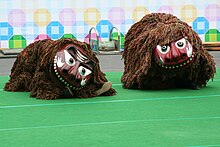
Lion dance as an exorcism ritual began to be performed in the New Yr in Korea during the Goryeo dynasty.[62] The all-time known of the Korean saja-noreum lion dances is the Bukcheong sajanoreum or lion mask play from Bukcheong. In this lion trip the light fantastic toe the panthera leo with a big but comic lion mask and chocolate-brown costume may be performed together with performers wearing other masks.[63] The dancers may be accompanied by musicians playing a double-headed drum, an hourglass-shaped drum, a big gong, and a six-holed bamboo flute.[64] The trip the light fantastic was originally performed every night of the first fifteen nights of the Lunar New Year, where the dance troupe in king of beasts masks and costumes visited every house in the villages of the Bukcheong region, and the panthera leo dance is meant to miscarry evil spirits and attract proficient luck for the coming year.[65] The optics of the lion mask may be painted gold to miscarry negative spirits. The king of beasts masks of Pongsan and Gangnyeong may feature rolling eyes and bells meant to affright demons when they make a sound as the lion moves.[62] Information technology is also believed that children who sat on the dorsum of the lion during such performances would savour good health and a long life.[62]
Tibetan Panthera leo [edit]
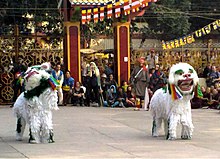
Tibetan Snowfall King of beasts Dance, Bodhgaya, Bharat
In the Himalayan and Tibetan area, there is also a lion trip the light fantastic called the snowfall lion dance. This dance may exist plant in Tibet and too among Tibetan diaspora communities where it is called Senggeh Garcham ,[66] Nepal, and parts of Northeastern India – among the Monpa people in Arunachal Pradesh,[67] in Sikkim where it is called Singhi Chham,[68] and in some parts of Uttar Pradesh and Ladakh. The name seng ge and its related forms come up from Sanskrit for lion siṅha,[69] and cham is a Buddhist ritual trip the light fantastic toe.[lxx] [71] The snow lion has white fur, and in Tibet, information technology may also have a dark-green mane or light-green fringes, while in Sikkim, the mane may be blue.
The Snow King of beasts is regarded as an keepsake of Tibet and the Snow Lion Trip the light fantastic is a pop trip the light fantastic in Tibetan communities and it is performed during festivals such every bit during the ritual dance (cham) festival and the New year. The snow lion represents the snowy mountain ranges and glaciers of Tibet and is considered highly auspicious, and it may also symbolize a number of characteristics, such as power and strength,[69] and fearlessness and joy.[72] [73] Some local versions of the snow lion trip the light fantastic may also accept been influenced by Chinese Lion Dance in the Sino-Tibetan borderland – for example, it was recorded that the local master in Songpan, Sichuan gave a panthera leo costume to the Jamyang Zhépa II of the Amdo region in the 18th century.[69] The snow king of beasts trip the light fantastic may be performed as a secular trip the light fantastic toe, or equally a ritual dance performed by bon po monks.[69]
Indonesian Lion [edit]
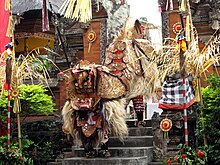
The Chinese panthera leo trip the light fantastic is referred to as barongsai in Indonesia, ofttimes performed by Chinese Indonesian during Imlek. Indonesians however, accept developed their own style of lion dances. The lion dance (Indonesian: barong ) in Indonesia has unlike forms that are distinct to the local cultures in Indonesia, and information technology is not known if these accept whatsoever relation to the Chinese king of beasts.[9] The best known panthera leo dances are performed in Bali and Coffee.

In Hindu Balinese civilization, the Barong is the king of adept spirits and the enemy of the demon queen Rangda. Similar the Chinese king of beasts, it requires more dancers than in the Javanese Reog, typically involving 2 dancers.
The Reog trip the light fantastic of Ponorogo in Java involves a king of beasts figure known as the singa barong . It is held on special occasions such as the Lebaran (Eid al-Fitr), City or Regency anniversary, or Independence 24-hour interval carnival. A single dancer, or warok , carries the heavy panthera leo mask nigh xxx – 40 kg weight past his teeth. He is credited with exceptional strength. The warok may also carry an adolescent boy or daughter on its head. When belongings an adolescent boy or girl on his head, the Reog dancer holds the weight up to total 100 kilograms. The bang-up mask that spans over ii.v meters with genuine tiger or leopard skin and existent peacock feathers. It has gained international recognition as the world's largest mask.

Another grade of Indonesian panthera leo dance is called Sisingaan from West Java.[74] Sisingaan marked by a form of a lion-shaped effigy palanquin that is carried by a group of dancers who perform various attractions accompanied by traditional music.[75] Thus lion palanquin is being ride by a children, and usually performed to celebrate the circumcision ceremony, where the child is carried on a lion effectually the kampung (village).[76]
East Africa [edit]
Around the globe there are lion dances that are local to their area and unrelated to the Chinese dance. For example, diverse tribes in East Africa, such every bit the Maasai and Samburu people of Kenya, used to perform a panthera leo dance to celebrate a successful lion hunt, considered by these tribes to be a prestigious act and a sign of bravery. The dancers may also reenact a lion chase. Some of them make a headdress out of the mane of the slain lion (or out of other animals) and wear the headdress in the dance.[77] Young men may likewise wear the king of beasts-mane headdress and dance in a coming-of-historic period ceremony.[78] [79] Yet, equally lion-hunting has been made illegal, the dance is seldom performed in a real scenario nowadays, but they may continue to perform the dance for tourists.[80]
Music and instruments [edit]


The Chinese Lion Dance is performed accompanied by the music of beating of tanggu (drum) (in Singapore, datanggu), cymbals, and gongs. Instruments synchronize to the lion trip the light fantastic movements and actions. Fut San, Hok San, Fut Hok, Chow Gar, etc. all play their beat differently. Each style plays a unique crush. Developments in electronic devices have immune music to exist played via phone/tablet/computer/mp3 histrion. This has contributed to the evolution of how people tin can play lion dance music - which eliminates the need to behave effectually instruments (which can be quite large).
The most common way is Sar Ping panthera leo dance beats. This has more than 22 different testings that you can use to evidence the lion's move, whereas fut san has only around 7.
Costumes [edit]
The lion dance costumes used in these performances tin can simply be custom fabricated in specialty craft shops in rural parts of Asia and take to exist imported at considerable expense for most foreign countries exterior Asia. For groups in Western countries, this is made possible through funds raised through subscriptions and pledges fabricated by members of local cultural and business societies. For countries like Malaysia with a substantial Chinese population, local expertise may exist available in making the "panthera leo" costumes and musical instruments without having to import them from Red china. Almost modernistic Southern Panthera leo trip the light fantastic costumes come with a gear up of matching pants, still some practitioners utilise black kung fu pants to announced more traditional. Modernistic panthera leo dance costumes are made to exist very durable and some are waterproof.
Association with Wushu/Kung Fu [edit]
The Chinese lion trip the light fantastic toe has close relations to kung fu or Wǔshù (武術) and the dancers are unremarkably martial art members of the local kung fu club or school. They practice in their club and some train hard to master the skill as one of the disciplines of the martial art. In full general, information technology is seen that if a schoolhouse has a capable troupe with many 'lions', it demonstrates the success of the school. It is also by and large practised together with Dragon trip the light fantastic in some surface area.
During Chinese New Years and festivals [edit]

During the Chinese New Year, lion dance troupes will visit the houses and shops of the Asian community to perform the traditional custom of "cai qing" (採青), literally meaning "plucking the greens", whereby the panthera leo plucks the auspicious green lettuce either hung on a pole or placed on a tabular array in front of the premises. The "greens" (qing) is tied together with a "red envelope" containing coin and may also include auspicious fruit like oranges. In Chinese cǎi (採, pluck) also sounds like cài (菜, significant vegetable) and cái (财, meaning fortune). The "lion" will dance and arroyo the "light-green" and "cherry envelope" similar a curious cat, to "eat the green" and "spit" information technology out but continue the "red envelope" which is the reward for the king of beasts troupe. The lion dance is believed to bring skillful luck and fortune to the business organisation. During the Qing Dynasty, at that place may exist boosted hidden meanings in the performances, for example the green vegetables (qing) eaten by the lion may represent the Qing Manchus.[81] The lion dance troupes are sometimes accompanied by various characters such equally the Large Head Buddha.[82]

Different types of vegetables, fruits, foods or utensils with auspicious and good symbolic meanings; for instance pineapples, pomelos, bananas, oranges, sugar cane shoots, coconuts, beer, clay pots or fifty-fifty venereal can exist used to be the "greens" (青) to be "plucked" to give different difficulty and challenge for the panthera leo dance performers. But the difficulties of the challenge should come up with the bigger the rewards of the "red envelope" given.
In the former days, the lettuce was hung 5–6 m (16–20 ft) above ground and only a well-trained martial creative person could accomplish the money while dancing with a heavy king of beasts head. These events became a public challenge. A big sum of coin was rewarded, and the audience expected a skillful show. Sometimes, if lions from multiple martial arts schools approached the lettuce at the aforementioned time, the lions are supposed to fight to determine a winner. The lions had to fight with stylistic lion moves instead of chaotic street fighting styles. The audition would judge the quality of the martial art schools according to how the lions fought. Since the schools' reputations were at stake, the fights were usually violent just civilized. The winner lion would then use creative methods and martial fine art skills to reach the loftier-hanging advantage. Some lions may dance on bamboo stilts and some may step on human pyramids formed by swain students of the schoolhouse. The performers and the schools would gain praise and respect on top of the large monetary reward when they did well.[ citation needed ]

Chinese panthera leo trip the light fantastic performing a "cai qing" where the "greens" are hung high in a higher place for the lion to pluck.
During the 1950s-60s, in some areas with loftier population of Chinese and Asian communities specially the Chinatown in many foreign countries abroad Cathay in the world, people who joined king of beasts dance troupes were "gangster-like" and there was a lot of fighting betwixt lion dance troupes and kung fu schools. Parents were agape to permit their children join king of beasts trip the light fantastic toe troupes because of the "gangster" association with the members. During festivals and performances, when lion trip the light fantastic toe troupes met, there may be fights between groups. Some lifts and acrobatic tricks are designed for the lion to "fight" and knock over other rival lions. Performers even hid daggers in their shoes and clothes, which could be used to injure other king of beasts dancers' legs, or even attached a metal horn on their lion's forehead, which could exist used to slash other lion heads. The violence became so extreme that at 1 point the Hong Kong regime banned king of beasts trip the light fantastic completely. At present, as with many other countries, lion trip the light fantastic toe troupes must attain a let from the government in order to perform panthera leo dance. Although there is still a certain degree of competitiveness, troupes are a lot less violent and aggressive. Nowadays, whenever teams meet each other, they'll milkshake easily through the mouth of the lion to show sportsmanship.[ citation needed ]
In a traditional functioning, when the dancing lion enters a village or township, information technology is supposed to pay its respects first at the local temple(s), then to the ancestors at the ancestral hall, and finally through the streets to bring happiness to all the people.
Evolution and competition [edit]

Lion trip the light fantastic toe in contest may be performed on a series of small circular platforms on poles like to the ones shown hither.
King of beasts dance has spread across the world due to the worldwide presence of the diaspora Chinese communities and immigrant settlers in many countries in the Americas, Europe, Asia, Africa, Commonwealth of australia, Pacific Polynesia, and in item, in Southeast Asia where there is a large overseas Chinese presence.
The dance has evolved considerably since the early days when information technology was performed every bit a skill part of Chinese martial arts, and has grown into a more artistic art and a sport as well that takes into accounts the lion's expression and the natural movements, likewise equally the development of a more elaborate acrobatic styles and skills during performances. This development and development has produced the modern form of lion dances, and competitions are held to detect the best lion dance performances.
International lion dance championships are held in many countries, for example in Malaysia, Singapore, Hong Kong and Taiwan.[83] The contest generally involves Southern Lion dance teams and may be performed on a series of small circular platforms raised on poles called jongs, and there are a total of 21 or even 22 poles in the traditional set.[84] These poles ranged from iv to 10 feet (1 to 3 g) in height, but title poles can go up to twenty to 26 feet (6 to 8 chiliad). The poles can be added with props or obstacles equally well, such every bit a small wooden bridge that can be easily broken in half, or a pair of wire lines that can be crossed over. The first jongs congenital were introduced in 1983 for a contest in Malaysia,[ commendation needed ] made out of wood with a small round condom platform on summit and an iron fitting on the lesser, with a full of 5 poles in the original set called the "May Hua Poles" Or "Plum Flower Poles", which were 33 inches in meridian and 8 inches in width. Subsequently, 16 or even 17 poles were added in the set, but all 21 or fifty-fifty 22 poles were 85.11 inches higher and 6 inches wider, and are made out of atomic number 26 instead.[ citation needed ] The competition is judged based on the skill and liveliness of the "lion" together with the inventiveness of the stunts and choreographed moves, every bit well as the difficulty of the acrobatics, and rhythmic and pulsating live instrumental accompaniment that can captivate the spectators and the judges of the competition. The master judging rubric was adult by the International Dragon and Panthera leo Trip the light fantastic Federation, scored out of 10 total points. Their rubric is used in many professional competitions including Genting, Malaysia, which is recently held at Arena of Stars since it was opened in 1998. The Genting Globe and National King of beasts Dance Championships are held every ii years in Malaysia, starting in the 1980s. The champion equally of 2018 is consecutive winner Kun Seng Keng from Muar, Johor, Malaysia, winners of xi out of the 13 Genting competitions,[85] as well as other competitors from Malaysia such as Gor Chor from Segamat, Johor, Malaysia, Hong Teik from Alor Setar, Kedah, Malaysia, Khuan Loke from Sungai Way, Petaling Jaya, Selangor, Malaysia, and Guang Yi Kwong Ngai from Seri Kembangan, Selangor, on the outskirts in the majuscule Kuala Lumpur, Malaysia. By 2001 and 2002, dragon dance teams are also involved in competitions at Genting as well. Another famous competition event held in Malaysia was the Tang Long Imperial World Dragon and Lion Dance Championship at Putra Indoor Stadium, Kuala Lumpur, Malaysia in 2002. It likewise as well involves both Northern and Southern King of beasts dance teams, but dragon dance teams besides. Another competition chosen the Ngee Ann Urban center National King of beasts Trip the light fantastic Championships are held every twelvemonth in Ngee Ann Urban center, Orchard Road, Singapore, starting in the 1990s.[86]
In politics [edit]
The lion dance is seen as a representative part of Chinese civilisation in many overseas Chinese communities,[87] and in some Southeast Asian countries, in that location were attempts to ban or discourage the trip the light fantastic in guild to suppress the Chinese cultural identity in those countries.[88] For instance, in Malaysia, lion dance was criticized by a Malay politician in the 1970s as not Malaysian in fashion and suggested that it exist changed to a tiger dance,[89] and it was banned except at Chinese New Year until 1990.[ninety] Lion trip the light fantastic toe became a matter of political and public argue near the national culture of the country.[87] During the Suharto era in Indonesia, public expression of Chinese culture was also banned and barongsai (lion trip the light fantastic toe) procession was considered "provocative" and "an affront to Indonesian nationalism".[91] This ban was however overturned afterward the collapse of the Suharto government in 1998, nonetheless the occasional local banning of the panthera leo dance notwithstanding occurred.[92]
In popular civilization [edit]
In the 1960s and 1970s, during the era when the Hong Kong's Chinese archetype and martial arts movies are very popular, kung fu movies including Jet Li's Wong Fei Hung has actually indirectly shows and indicates how lion dance was practiced with the kung fu shut co-relation and kung fu during that time, e.g. Dreadnaught and Martial Society. In those days the lion dance was more often than not practised and performed as Wushu or kung fu skills, with the challenge for the 'lion' built of chairs and tables stacked up together for the 'lion' to perform its stunts and achieve its challenge.[ commendation needed ]
In the 1976 musical, Pacific Overtures by Stephen Sondheim, the starting time act ends with a musical number titled "Lion dance".[93] The Commodore Perry grapheme performed a mixture of a kabuki version of panthera leo dance and a cakewalk wearing an Uncle Sam costume and the long white wig and makeup of a kabuki lion, here used to express his feelings of success at having met with Japanese officials and opened Japan to trade for the start fourth dimension in 250 years.[94] The kabuki lion dance also appeared in the 1957 film Sayonara with Ricardo Montalbán.[94]
Several 1990s movies, including a remade version of Wong Fei Hung, and the sequels of In one case Upon a Time in China, involve plots centered on lion dancing, especially Once Upon a Time in China Three and Four. The series' primary actor, Jet Li, has performed as a lion dancer in several of his films, including Northern style panthera leo dancing in Shaolin Temple, Shaolin Temple two: Kids from Shaolin, Shaolin Temple 3: North and South Shaolin and Southern mode king of beasts dancing in In one case Upon a Time in China III and One time Upon a Fourth dimension in China and America.[ citation needed ]
Other films include The Young Chief, Lion vs. Lion, Dancing Panthera leo, The Panthera leo Men, The King of beasts Men: Ultimate Showdown, King of beasts Dancing and Lion Dancing two and I Am What I Am.[ citation needed ]
Panthera leo trip the light fantastic has also appeared in popular music videos, such equally Chinese hip hop grouping College Brothers music video for their single "Open Information technology Up", Adam Lambert'due south music video "If I Had You", and Zayn Malik featuring Sia's music video "Dusk Till Dawn". The same traditional dance as well appeared in a music video "Truthful To Your Heart" by 98 Degrees featuring Stevie Wonder, which was used to annunciate the 1998 Disney animated moving-picture show Mulan.[ commendation needed ]
See also [edit]
- Chinese New Year
- Japanese New Year
- Vietnamese New year's day (Tết)
- Korean New year
- Culture of China
- Chinese guardian lions
- Trip the light fantastic toe in China
- Pantomime horse
- Dragon dance
- Tiger dance
- Qilin trip the light fantastic toe
- Shisa
Notes [edit]
- ^ a b Fan Pen Li Che (2007). Chinese Shadow Theatre: History, Pop Religion, and Women Warriors. McGill-Queen'southward University Press. p. 64. ISBN978-0773531970.
- ^ "Shang Shu - Yu Shu - Yi and Ji". Chinese Text Projection.
- ^ Wang Kefen (1985). The History of Chinese Dance. China Books & Periodicals. pp. 25–27. ISBN978-0835111867.
- ^ Faye Chunfang Fei, ed. (2002). Chinese Theories of Theater and Functioning from Confucius to the Nowadays. University of Michigan Printing. pp. 24–25. ISBN978-0472089239.
- ^ a b "Hinc sunt leones — 2 ancient Eurasian migratory terms in Chinese revisited" (PDF). International Journal of Central Asian Studies. ix. 2004. ISSN 1226-4490.
- ^ Berthold Laufer (1976). Kleinere Schriften: Publikationen aus der Zeit von 1911 bis 1925. ii v. p. 1444. ISBN978-3515026512.
- ^ Mona Schrempf (2002), "chapter vi - The Earth-Ox and Snowlion", in Toni Huber (ed.), Amdo Tibetans in Transition: Lodge and Culture in the Post-Mao Era, Brill, p. 164, ISBN9004125965,
During the Persian New year of Newruz, a panthera leo dance used to be performed past immature boys, some of them naked it seems, who were sprinkled with cold h2o. They were thus supposed to drive out evil forces and the cold of the wintertime.
- ^ a b Marianne Hulsbosch; Elizabeth Bedford; Martha Chaiklin, eds. (2010). Asian Fabric Culture. Amsterdam University Press. pp. 112–118. ISBN9789089640901.
- ^ a b Laurence East. R. Picken (1984). Music for a Lion Dance of the Song Dynasty. Musica Asiatica: volume 4. Cambridge University Press. p. 201. ISBN978-0521278379.
- ^ Wolfgang Behr (2004). "Hinc sunt leones — two ancient Eurasian migratory terms in Chinese revisited" (PDF). International Periodical of Central Asian Studies. ix.
- ^ Wilt L. Idema, ed. (1985). The Dramatic Oeuvre of Chu Yu-Tun: 1379 - 1439. Brill. p. 52. ISBN9789004072916.
- ^ a b c d e Wang Kefen (1985). The History of Chinese Dance. China Books & Periodicals. p. 53. ISBN978-0835111867.
- ^ 漢書 卷二十二 ‧ 禮樂志第二,
Original text: 孟康曰:「象人,若今戲蝦魚師子者也。」translation: Xiàngrén (Imitators) are like those [dancers] who act as frogs, fish, or lions today
- ^ "伎乐盛境". 佛教文化. Archived from the original on 2016-03-05. Retrieved 2014-01-10 .
- ^ "洛陽伽藍記/卷一".
四月四日,此像常出,辟邪師子導引其前。吞刀吐火,騰驤一面;彩幢上索,詭譎不常。奇伎異服,冠於都市。
- ^ Seiroku Noma (1943). Nihon kamen shi 日本假面史. Geibun Shoin.
- ^ "通典/卷146". Tongdian. Original text: 太平樂,亦謂之五方師子舞。師子摯獸,出於西南夷天竺、師子等國。綴毛為衣,象其俛仰馴狎之容。二人持繩拂,為習弄之狀。五師子各依其方色,百四十人歌太平樂,舞抃以從之,服飾皆作崑崙象。
- ^ Carol Stepanchuk; Charles Choy Wong (1992). Mooncakes and Hungry Ghosts: Festivals of Communist china. China Books & Periodicals. p. 38. ISBN978-0835124812.
- ^ "樂府雜錄". Yuefu Zalu.
Original text: 戲有五方獅子,高丈餘,各衣五色。每一獅子有十二人,戴紅抹額,衣畫衣,執紅拂子,謂之「獅子郎」,舞《太平樂》曲。
- ^ "《西凉伎》". Archived from the original on 2014-02-xix. Retrieved 2014-01-12 .
西凉伎,假面胡人假狮子。刻木为头丝作尾,金镀眼睛银贴齿。奋迅毛衣摆双耳,如从流沙来万里。紫髯深目两胡儿,鼓舞跳粱前致辞。
- ^ 陳正平 (2000). 唐詩趣談. Taiwan written report published Ltd. pp. 140–145. ISBN978-9866318580.
- ^ Dorothy Perkins, ed. (1998). Encyclopedia of China: History and Civilization. Facts On File Inc. p. 354. ISBN978-0816026937.
- ^ a b "Lion Dance". China Daily.
- ^ "South King of beasts: the Guangzhou Lion Dance". Life of Guangzhou. 13 February 2009.
- ^ "Taipei (Taiwanese Panthera leo)". Shaolin Lohan Pai Dance Troupe. Archived from the original on 2014-08-10.
- ^ "狮舞(青狮)项目简介". Archived from the original on 2017-07-19. Retrieved 2014-01-28 .
- ^ Chan, Margaret (2006). Ritual is Theatre, Theatre is Ritual. p. 159. ISBN9789812481153.
- ^ "沈丘回族文狮舞". The People'southward Government of Henan Province.
- ^ "沈丘槐店文狮舞1". 回族文狮子文化网. Archived from the original on 2014-02-04.
- ^ "Folk artists rehearse panthera leo dance for upcoming Chinese Lunar New Yr in China'south Gansu". Xinhua. 22 December 2019.
- ^ 陳正平 (2000). 唐詩趣談. Taiwan study published Ltd. p. 146. ISBN978-9866318580.
- ^ "Besides The King of beasts". The Lion Arts. Archived from the original on vii November 2017.
- ^ "Qilin Dancing During the Lunar New Yr and Southern Chinese Martial Civilization". Kung Fu Tea.
- ^ "The Hakka Chinese: Their Origin, Folk Songs And Plant nursery Rhymes". Archived from the original on 2016-03-04. Retrieved 2014-02-03 .
- ^ a b c d "The Divergence in King of beasts Trip the light fantastic". The Lion Arts.
- ^ Benji Chang (2013). "Chinese Lion Dance in the United States". In Xiaojian Zhao; Edward J.West. Park (eds.). Asian Americans: An Encyclopedia of Social, Cultural, Economic, and Political History. Greenwood Press. ISBN978-1598842395.
- ^ "Making a Chinese Lion Head". The Chinese Art of Panthera leo Dancing. Archived from the original on 2014-02-22.
- ^ Lim Chey Cheng. "The Lion Dance Costume Maker" (PDF). Friends of the Museums.
- ^ Grub Ee-Tan (February 12, 1996). "Lion Dance King". New Straits Times.
- ^ "About Us". Singapore Hok San Association.
- ^ "Southern (Cantonese) Lions". Shaolin Lohan Pai Lion Trip the light fantastic toe Troupe. Archived from the original on 2014-02-01.
- ^ "醒獅的由來". Archived from the original on 2008-06-27.
- ^ a b c "Hidden Meanings In the Southern Cantonese King of beasts Dance Costume". Chinese Panthera leo Dancers. Archived from the original on 28 Baronial 2011.
- ^ a b "Green Lion 青狮". Chinatownology.
- ^ "Lion Trip the light fantastic in Tay and Nung Ethnic Civilization". Haivenu Travel Blogs. Archived from the original on 2016-06-24. Retrieved 2016-05-21 .
- ^ "Nha Nhac of Hue Court". Vietnamese Dance. April fifteen, 2011.
- ^ "Ông Địa". Phật Giáo Hòa Háo Texas. Archived from the original on March 4, 2007.
- ^ a b Herbert Plutschow (November 5, 2013). Matsuri: The Festivals of Nihon: With a Selection from P.One thousand. O'Neill's Photographic Archive of Matsuri. Routledge. pp. 131–132. ISBN9781134246984.
- ^ Marianne Hulsbosch; Elizabeth Bedford; Martha Chaiklin, eds. (2010). Asian Material Culture. Amsterdam University Press. p. 110. ISBN9789089640901.
- ^ "Permit a King of beasts Seize with teeth Your Head (for Good Luck)". Deep Japan. 15 March 2014.
- ^ "Kobe, 1906 New year's day Celebrations 13". Old Photos of Nippon.
- ^ a b Benito Ortolani (1995). The Japanese Theatre: From Shamanistic Ritual to Contemporary Pluralism. Princeton University Press. pp. 26–27. ISBN978-0691043333.
- ^ Benito Ortolani (1995). The Japanese Theatre: From Shamanistic Ritual to Gimmicky Pluralism. Princeton University Press. p. xvi. ISBN978-0691043333.
- ^ Terence Lancashire (2011). An Introduction to Japanese Folk Performing Arts. Ashgate. p. vii. ISBN978-1409431336.
- ^ a b Yonei Teruyoshi. "Shishi-mai". Encyclopedia of Shinto.
- ^ "石橋物".
- ^ Brian Bocking (1997). A Popular Dictionary of Shinto. Routledge. p. 134. ISBN978-0700710515.
- ^ "Sounds of Korea > King of beasts Trip the light fantastic toe". KBS Earth Radio. Apr seven, 2013.
- ^ a b Keith Pratt; Richard Rutt, eds. (1999). Korea: A Historical and Cultural Dictionary. Routledge. p. 271. ISBN978-0700704637.
- ^ "Eunyul Talchum (Mask Dance Drama of Eunyul)". Cultural Heritage Administration.
- ^ "Korean Mask Dances". Asianinfo.org.
- ^ a b c National Research Institute of Cultural Heritage (25 December 2015). Tal and Talchum. Gil-Job-Ie Media. p. 27. ISBN9788963257358.
- ^ "Traditions revived during Seollal holidays". Korean Herald. 2010-04-04.
- ^ "Masks & the Mask Dance". Korea.net. September sixteen, 2014.
- ^ "Bukcheong Saja-nori". Asia-Pacific Database on Intangible Cultural Heritage (ICH).
- ^ "Tibetan Snow King of beasts Dance". Tibet Views. Archived from the original on 2018-11-28. Retrieved 2014-01-xi .
- ^ "Tawang Festival". India Travel. Archived from the original on 2013-01-25.
- ^ Shobhna Gupta (2007). Dances of India. Har-Anand. p. 76. ISBN978-8124108666.
- ^ a b c d Mona Schrempf (2002), Toni Huber (ed.), Amdo Tibetans in Transition: Club and Culture in the Mail-Mao Era (PDF), Brill, pp. 147–169, ISBN9004125965
- ^ "Cham dances". Fabric Tibet.
- ^ "Gar Cham – Meditative Dance – "Lama Dance"". Samye.
- ^ "Legend of the SnowLion". Snow King of beasts Tour.
- ^ "Tibetan Buddhist Symbols". A view on Buddhism.
- ^ "Sisingaan, Sindiran Ala Orang Sunda". Republic of indonesia.get.id (in Indonesian). 23 December 2019.
{{cite web}}: CS1 maint: url-status (link) - ^ Dipa, Arya (3 June 2014). "Preserving hamlets via fine art in Sekejolang". The Jakarta Postal service . Retrieved 2021-02-25 .
- ^ "Sisingaan". kompas.id . Retrieved 2021-02-25 .
- ^ Istvan Praet (15 August 2013). Animism and the Question of Life. Routledge. p. 83. ISBN9781134500598.
- ^ Paul Spencer (March 2004). The Maasai of Matapato: A Study of Rituals of Rebellion. Routledge. p. 147. ISBN9781134371662.
- ^ "Warriors of the Maasai".
- ^ N. W. Sobania (2000). Culture and Customs of Republic of kenya. Praeger Publishers. p. 205. ISBN978-0313314865.
- ^ Marianne Hulsbosch; Elizabeth Bedford; Martha Chaiklin, eds. (2010). Asian Textile Culture. Amsterdam University Press. p. 117. ISBN9789089640901.
- ^ Yap, Joey. The Art of Lion Dance. pp. 102, 105. ISBN9789671303870.
- ^ Malaysia Muar King of beasts Dance Troupe is Globe Champion|New Straits Times |11 Feb 1994
- ^ Wang, Marina (nine February 2021). "Malaysia Has Turned King of beasts Dancing Into a Gravity-Defying Extreme Sport". Atlas Obscura.
- ^ Elan Perumal (28 July 2018). "Lion dancers dazzle with football stunts". The Star.
- ^ "Who will be The King of beasts (dance) King?". Straits Times. ten September 2019.
- ^ a b Sharon A. Carstens (2012). "Chapter 8, Dancing Lions and Disappearing History: The National Civilisation Debates and Chinese Malaysian Civilization". Histories, Cultures, Identities: Studies in Malaysian Chinese Worlds. NUS Printing. pp. 144–169. ISBN978-9971693121.
- ^ Wanning Sun, ed. (2006). Media and the Chinese Diaspora: Community, Communications and Commerce. Routledge. p. ten. ISBN978-0415352048.
- ^ by Thou. Jocelyn Armstrong; R. Warwick Armstrong; K. Mulliner, eds. (2001). Chinese Populations in Gimmicky Southeast Asian Societies: Identities, Interdependence and International Influence. Routledge. p. 222. ISBN978-0700713981.
- ^ Jean Elizabeth DeBernardi (2004). Penang: Rites of Belonging in a Malaysian Chinese Community. Stanford Academy Press. p. 255. ISBN978-0804744867.
- ^ Leo Suryadinata (2008). Ethnic Chinese in Contemporary Indonesia. Institute of Southeast Asian Studies.
- ^ "Chinese Lion Dance Banned in Indonesia'southward Aceh". Dki jakarta Globe. Dec 21, 2009. Archived from the original on Feb 23, 2014. Retrieved Feb x, 2014.
- ^ "Pacific Overtures". The Stephen Sondheim Reference Guide.
- ^ a b Sheppard, William Anthony (2019). Extreme Exoticism. p. 373. ISBN9780190072704.
External links [edit]
 | Wikimedia Eatables has media related to Lion dance. |
- The Genuine History Of Lion Dance
- The Beginner'south Guide to Chinese Lion Dance
- An in-depth article on the Chinese King of beasts Trip the light fantastic
- Data about Green Lions
- Boosted data about king of beasts dance
- The Chinese King of beasts Dance
- About Lion Dance [ permanent dead link ]
- Malaysia Muar Lion Dance Troupe is World Champion New Straits Times eleven Feb, 1994
- Korean Insights - Madangguk: Mask Dance-Drama

Posting Komentar untuk "Yees Martial Arts Lion Dance Yees Martial Arts Lion Dance"